
Cash App has agreed to a $12.5 million class action settlement resolving claims that it sent unsolicited referral text messages, a case now widely referred to as the $12.5M Settlement. The agreement covers Washington state residents who allegedly received promotional texts without consent, underscoring growing legal scrutiny of digital marketing, consumer privacy, and automated messaging practices.
$12.5M Settlement Overview- $147 Payment for Everyone
| Key Fact | Detail |
|---|---|
| Settlement amount | $12.5 million |
| Defendant | Block, Inc. (Cash App) |
| Affected group | Washington residents |
| Core allegation | Unsolicited referral text messages |
| Laws cited | CEMA, Consumer Protection Act |
While individual payments under the $12.5M Settlement may be modest, consumer advocates say the case sends a broader message: companies that rely on digital outreach must carefully balance innovation with respect for consent and privacy, particularly as state-level enforcement continues to expand.
What the $12.5M Settlement Lawsuit Alleges
The lawsuit centers on Cash App’s “Invite Friends” referral feature, a tool designed to encourage user growth by allowing customers to send promotional text messages to contacts in their phone books.
Plaintiffs alleged that many recipients never consented to receive these messages and had no prior relationship with Cash App. According to the complaint, the messages constituted commercial advertising and violated Washington’s Commercial Electronic Mail Act (CEMA), which strictly regulates unsolicited electronic communications.
Although individual users technically initiated the messages, the lawsuit argued that Cash App materially participated by drafting standardized message language, providing the technological infrastructure, and benefiting financially from each successful referral.
Legal filings state that under Washington law, companies may still bear responsibility when they substantially assist or encourage unlawful messaging practices, even if users press “send.”
Block, Inc., which owns and operates Cash App, denied all allegations. In settlement documents, the company stated that it agreed to resolve the dispute to avoid the costs, risks, and uncertainty associated with continued litigation.
Why Washington State Law Matters
Washington’s Commercial Electronic Mail Act is widely regarded as one of the toughest state-level anti-spam laws in the United States.
Unlike federal regulations such as the CAN-SPAM Act, Washington law allows private individuals to sue companies directly and recover statutory damages without proving financial harm. This legal structure has made the state a focal point for litigation involving text messages, emails, and digital advertising.
Consumer protection attorneys say the $12.5M Settlement reflects how state-level laws can influence national business practices.
“Washington’s statute gives consumers meaningful leverage,” said a legal analyst specializing in privacy law. “It forces companies to be much more careful about how consent is obtained and documented.”
Who Is Eligible for Cash App Settlement Compensation of $147 Payment for Everyone
Eligibility under the $12.5M Settlement is narrowly defined.
To qualify, individuals must have:
- Lived in Washington state at the time they received the text message
- Received at least one Cash App referral or promotional text
- Not provided express prior consent to receive marketing texts
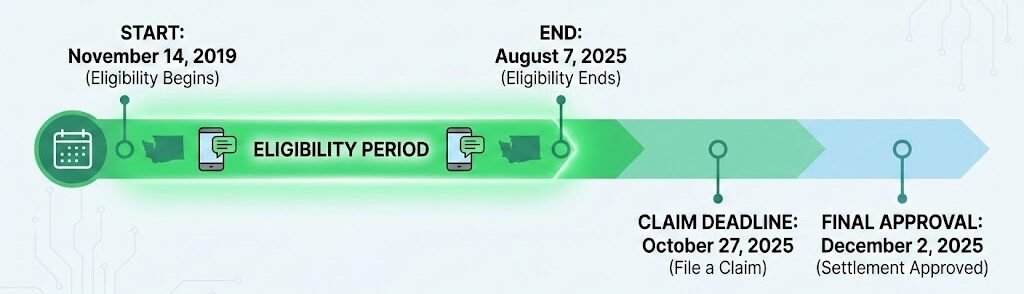
The eligible period spans from November 14, 2019, through August 7, 2025, according to court records.
Settlement administrators may verify claims using phone numbers, carrier records, or sworn statements submitted under penalty of perjury.
How Much Money Claimants May Receive
The gross settlement fund totals $12.5 million. From that amount, deductions will be made for attorneys’ fees, litigation expenses, administrative costs, and incentive awards for the named plaintiffs.
The remaining funds will be distributed on a pro-rata basis to approved claimants. Based on current estimates, individual payments are expected to range from approximately $88 to $147, depending on how many people submit valid claims.
Settlement administrators emphasize that the advertised figures represent estimates, not guarantees. Higher participation generally results in smaller per-person payments.
No payments will be issued unless the settlement receives final court approval.
How the Claims Process Works For Cash App Settlement
Claimants were required to submit a claim form by the court-approved deadline. The process typically involved:
- Providing contact information
- Confirming Washington residency during the eligible period
- Identifying the phone number that received the message
Unlike some consumer settlements, proof of the actual text message was not always required, though false claims may result in disqualification or legal penalties.
Once claims are validated, funds are distributed electronically or by check.
How This Case Fits Into Broader Privacy Enforcement
The $12.5M Settlement is part of a broader national trend in which courts and regulators are increasingly examining how companies collect and use consumer contact data.
Text messaging has become a powerful marketing channel, but it is also highly regulated because of its personal and intrusive nature. Laws governing consent vary widely by jurisdiction, creating compliance challenges for companies operating nationwide.
Privacy experts say referral programs, in particular, occupy a legal gray area.
“Businesses often assume referral messages are safe because users initiate them,” said a digital privacy researcher. “But courts are looking at who benefits and who controls the system.”
Comparison With Similar Settlements
The Cash App case is not unique. Other companies have faced lawsuits over referral texts, promotional SMS campaigns, and automated notifications.
Recent years have seen multi-million-dollar settlements involving retailers, ride-sharing platforms, and financial services firms accused of violating state or federal messaging laws.
Compared with those cases, legal analysts say the $12.5M Settlement is notable both for its size and for its reliance on state-specific consumer protection statutes rather than federal law.
What Cash App Has Said Publicly
Block, Inc. has consistently denied that it violated any laws.
In settlement filings, the company stated that it does not believe the referral texts were unlawful and emphasized that the agreement does not constitute an admission of wrongdoing.
The company also noted that it has revised certain aspects of its referral and messaging disclosures since the lawsuit was filed, though it did not specify whether those changes were directly related to the litigation.
Cash App remains one of the most widely used peer-to-peer payment platforms in the United States, reporting tens of millions of active monthly users in its most recent earnings reports.
Impact on Consumers Who Did Not File Claims
Consumers who did not submit a claim by the deadline will not receive compensation. However, they will still be bound by the settlement’s terms, meaning they cannot pursue separate legal action over the same allegations.
Legal experts say this is a standard feature of class action settlements and underscores the importance of paying attention to official settlement notices.
What This Means for Digital Marketing Practices
Industry observers say the $12.5M Settlement could influence how companies design referral and viral growth tools.
Businesses may:
- Require clearer consent language
- Limit automated text-based referrals
- Shift toward email or in-app invitations
- Increase record-keeping around consent
While referral marketing remains legal, the case highlights the risks of aggressive growth strategies that rely on personal contact data.
What Happens Next
A federal judge will review the settlement for fairness, adequacy, and reasonableness at a final approval hearing scheduled later this year.
If approved, payments are expected to be distributed several months afterward. If the court rejects the settlement, the parties could renegotiate or resume litigation.
For now, the case stands as one of the more prominent examples of how consumer privacy law continues to evolve in the digital economy.
FAQs About $147 Payment for Everyone
Is the $12.5M Settlement available nationwide?
No. Eligibility is limited to Washington state residents.
Do former Cash App users qualify?
Yes, provided they meet the residency and message-receipt requirements.
Will this affect my Cash App account?
No. Participation does not affect account status.
Is the payment taxable?
Settlement payments may be taxable. Claimants are advised to consult a tax professional.
