
If you’ve been seeing posts about a potential $2,000 check tied to tariffs, the core idea is this: President Donald Trump has discussed sending out a “tariff dividend” funded by money collected from import tariffs. In plain terms, the government collects tariff revenue at the border, and the proposal is to return some of that money to Americans as a cash payment. At the same time, it’s important to keep expectations realistic. Major economic analysis notes that key details are still not locked in, and a program at this scale would typically need legislation that spells out who qualifies, how payments are delivered, and how the funding works in practice.
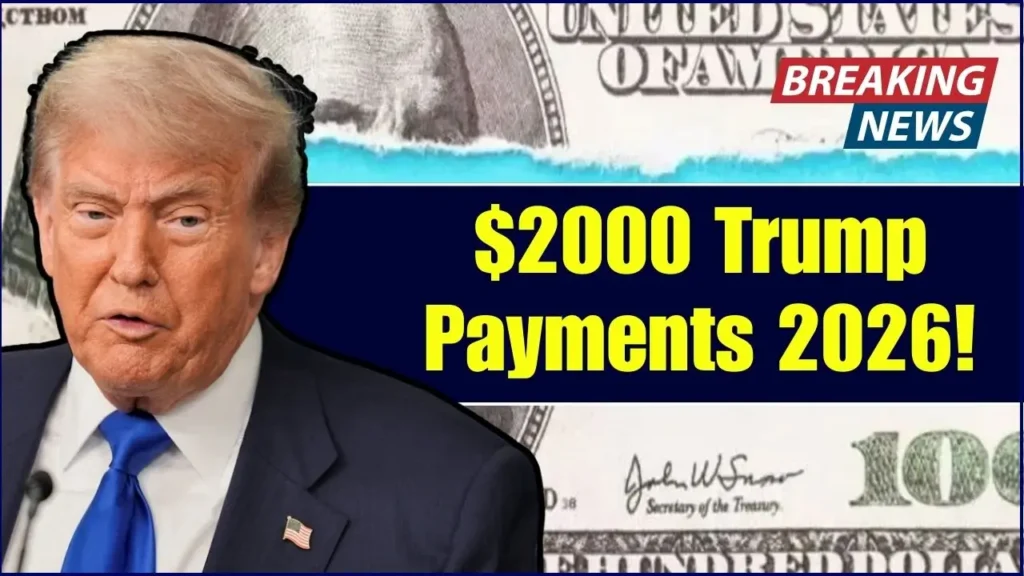
The reason “2026” keeps coming up is that public reporting has tied the concept to a mid-2026 timeframe, but that’s not the same thing as a guaranteed payment schedule. Even supporters of the idea have not produced a final, official plan that answers the big questions taxpayers actually care about, like whether the benefit is universal, whether it phases out by income, and whether dependents count. President Trump has said the dividend would be at least $2,000 per person and would go to everyone except “high income people,” but analysis points out that “high income” has not been defined through a specific threshold in enacted policy. That missing definition is exactly why you’ll see different articles and social posts claiming different eligibility rules.
$2000 Trump Payments
Calling it a dividend frames the payment as a return of collected revenue rather than a traditional stimulus, but economically the household impact still depends on two forces happening at once: a check arriving and potential price effects from tariffs. So, the question isn’t only “Will a check arrive?” but also “Will tariffs change prices and interest rates in a way that reduces the value of that check?”
- The “tariff dividend” idea is framed as using tariff revenue to fund direct payments, with Trump describing a $2,000 level and an exclusion for “high income people.”
- Analysts stress that the plan lacks finalized program mechanics and would likely require legislation to define eligibility and payment delivery.
- Economic modeling suggests checks could boost spending but may also create inflation pressure and affect interest rates.
Tariff Rebate Checks Unlikely To Materialize
- The biggest obstacle is the math. Even if tariffs generate substantial revenue, a $2,000 payment to a large share of households becomes an enormous budget line item fast. In TD Economics’ modeled scenario using income thresholds similar to earlier stimulus-style designs, the estimated cost is around $250 billion for one round of payments.
- That cost matters because it collides with competing priorities: lawmakers could prefer using tariff revenue to lower deficits, fund other programs, or offset other tax changes rather than mailing checks. It also matters because if the revenue is volatile, policymakers may hesitate to create a popular payment that becomes politically difficult to stop later.
What “Unlikely” Actually Means for Readers
“Unlikely to materialize” doesn’t mean “impossible.” It means that, based on current analysis, the political and fiscal hurdles are high enough that you should not plan your rent, debt payoff, or major purchase around receiving the money. If the proposal moves forward, the most likely changes would be tighter income limits, smaller payments, or a different structure such as a refundable credit rather than a widely issued check.
Packing Economic Punch
- If payments did go out, the near-term effect could be real. TD Economics’ modeling suggests that sending $2,000 checks to eligible households could lift consumer spending in 2026, especially because many families would use the money for everyday expenses, debt payments, and delayed purchases. In their scenario where payments arrive in Q3 2026, TD estimates consumption could rise about 0.7 percentage points in 2026 compared with their baseline outlook.
- That’s why the idea is politically attractive: cash payments are simple to explain, and they can be felt quickly in household budgets. For many families, $2,000 could cover a month of groceries, knock down high-interest credit card balances, rebuild emergency savings, or help with car repairs and medical bills.
Who Benefits Most if Checks Happen
In most rebate-style designs, the biggest day-to-day impact tends to show up in low- and middle-income households because the payment is a larger share of their annual budget. That’s also why income limits matter so much: if the program is capped, it may concentrate benefits where the money is more likely to be spent quickly, increasing the short-run economic “kick.”
But At The Wrong Time
- The downside is the macro side effect: when lots of people get cash at the same time, demand rises. TD estimates that under a full-check scenario, core PCE inflation could run about 0.2 percentage points higher in both 2026 and 2027 than it otherwise would.
- Inflation isn’t just an abstract number. If inflation runs hotter, the Federal Reserve can be more cautious about cutting rates, which can keep borrowing costs elevated. That can affect mortgage affordability, car loan payments, small business borrowing, and even credit card rates that are tied to broader interest-rate conditions.
The Practical Household Tradeoff
A $2,000 payment feels strongest when prices are stable and financing gets cheaper. If prices rise or rates stay “higher for longer,” some of the benefit of the payment can be offset by higher monthly costs elsewhere.
What It Means For Your Money
If you want a smart way to approach this topic without getting trapped by hype, focus on “signals” that would indicate the proposal is becoming real:
- A specific bill introduced that spells out eligibility, income limits, and whether dependents qualify.
- Clear language on whether the benefit is a one-time payment, multiple rounds, or a tax credit claimed on a return.
- Updated scoring or analysis showing how the payment would be funded if tariff revenue is lower than expected.
How to Plan Right Now
- Don’t budget the $2,000 as guaranteed income until legislation is enacted and an agency provides an official program timeline.
- If it does happen, use it for the highest-impact moves first: paying down high-interest debt, rebuilding an emergency fund, or covering essential bills.
- Be cautious with big new monthly commitments (new car payment, large loan) based on a one-time payment that may never arrive.
