
The 1909–1958 Wheat Penny Price Chart highlights how some of America’s most common historical coins can carry values far beyond one cent, depending on rarity, condition, and minting errors. Numismatists say a small number of Lincoln Wheat Pennies remain highly sought after, even as most circulate at modest premiums.
1909–1958 Wheat Penny Price Chart
| Key Fact | Detail |
|---|---|
| Minting period | 1909–1958, marking Lincoln’s centennial |
| Typical value range | $0.03 to $20 for most coins |
| Most famous key date | 1909-S VDB |
| Rare error standout | 1943 copper cent |
| Value drivers | Rarity, condition, mint mark, errors |
Although most Wheat Pennies carry only modest premiums, a narrow group continues to command exceptional prices. For collectors, the appeal lies in a blend of history, scarcity, and craftsmanship. As one longtime dealer observed, “Each Wheat Penny reflects its era—some simply tell a more valuable story.”
Understanding the Lincoln Wheat Penny Era
The Lincoln Wheat Penny was minted by the United States from 1909 through 1958, marking the 100th anniversary of Abraham Lincoln’s birth. It represented a major departure from previous American coinage, which had traditionally favored allegorical imagery rather than real people.
According to the U.S. Mint, sculptor Victor David Brenner’s portrait of Lincoln was chosen for its realism and dignity. The reverse design—two stylized wheat ears framing the denomination—symbolized national prosperity and agricultural strength during the early 20th century.
The coin circulated during some of the most turbulent decades in American history, including two world wars, the Great Depression, and the postwar economic expansion. That long production run explains why millions of Wheat Pennies survive today, while only a small fraction command high prices.
What the 1909–1958 Wheat Penny Price Chart Shows
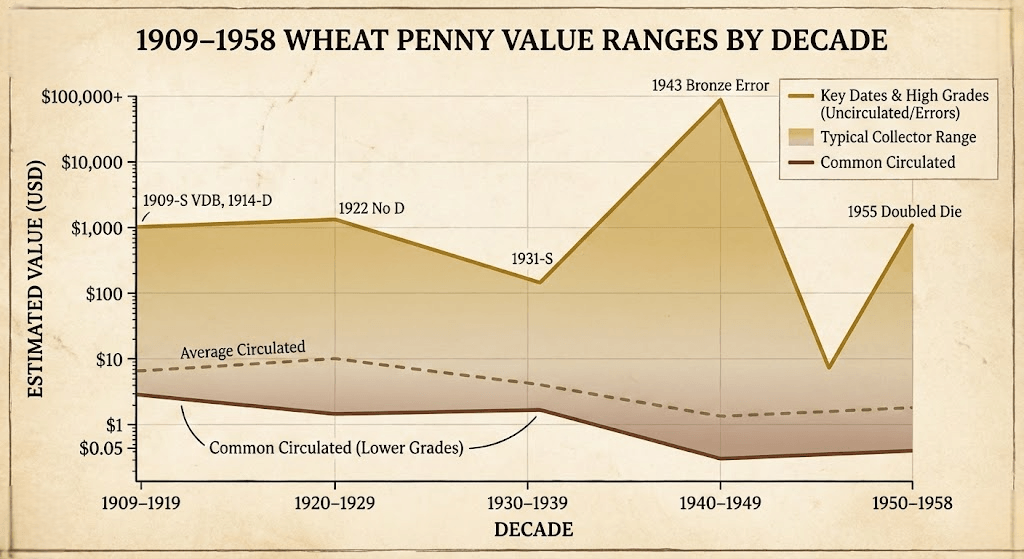
The 1909–1958 Wheat Penny Price Chart serves as a snapshot of how scarcity and demand interact over time. While most Wheat Pennies are common, the chart reveals dramatic value differences between otherwise similar coins.
Typical Market Ranges
- Common circulated examples: 3 to 10 cents
- Cleaner or lightly circulated coins: $0.50 to $5
- High-grade or semi-scarce dates: $20 to $200
- Key dates and major errors: Hundreds to hundreds of thousands of dollars
Professional Coin Grading Service (PCGS) reports that condition remains the single most important factor for pricing, aside from extreme rarity. Two coins from the same year can differ in value by several thousand dollars based solely on wear.
Key Dates That Drive High Prices
Certain years consistently appear at the top of the Wheat Penny value hierarchy due to limited mintages or unique circumstances.
1909-S VDB
The most widely recognized Wheat Penny is the 1909-S VDB. Only 484,000 examples were struck before public criticism led to the removal of Brenner’s initials.
Auction records from Heritage Auctions show that even well-worn examples routinely sell for several hundred dollars, while mint-state specimens can exceed $50,000.
1914-D
The Denver Mint produced relatively few cents in 1914. Combined with heavy circulation in the American West, surviving high-grade examples are scarce.
1931-S
Minted during the Great Depression, the 1931-S penny had one of the lowest mintages of the series. Collectors began saving them early, but demand has continued to rise steadily.
Wartime Errors and Extraordinary Rarities
World War II created one of the most unusual chapters in American coinage.
In 1943, the U.S. Mint replaced copper with zinc-coated steel to conserve metal for military production. Almost all cents struck that year are magnetic and silver-gray in appearance.
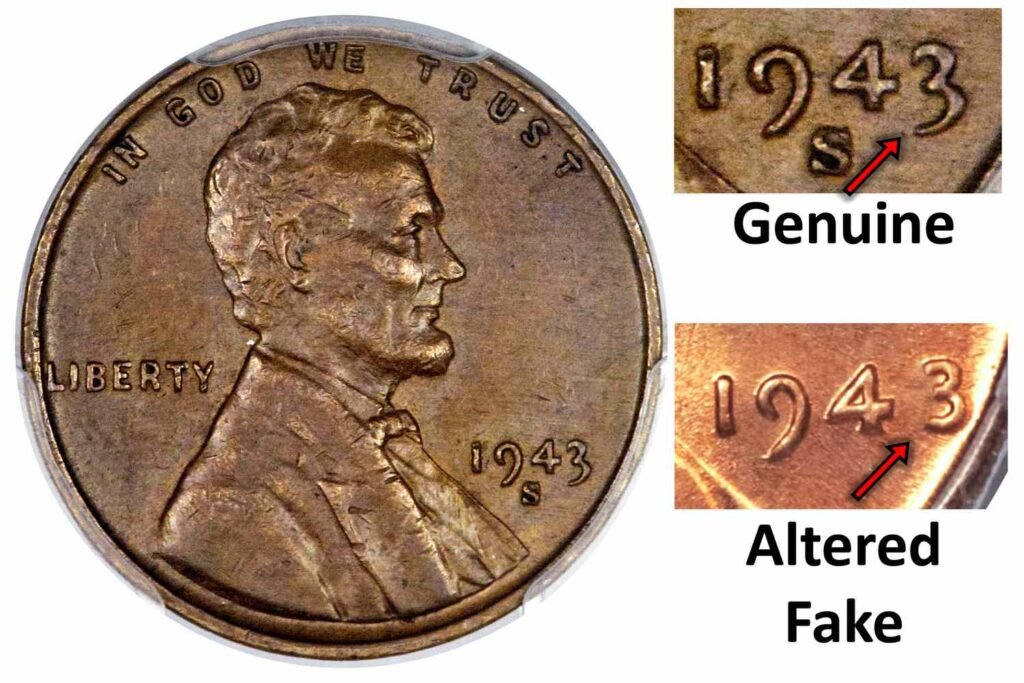
A very small number of copper blanks from 1942 were accidentally used in 1943. According to the Smithsonian National Numismatic Collection, fewer than two dozen genuine examples are confirmed across all mints.
These coins have become legendary within coin collecting, with authenticated examples selling for prices comparable to fine art.
The Role of Errors Beyond 1943
While the 1943 copper cent receives the most attention, other errors also influence the 1909–1958 Wheat Penny Price Chart.
1955 Doubled Die
One of the most famous mint errors in U.S. history, the 1955 Doubled Die cent displays strong doubling on the date and inscriptions. Experts estimate several thousand entered circulation.
Repunched Mint Marks and Die Cracks
Smaller errors, such as repunched mint marks or cracked dies, usually command modest premiums but remain popular with specialists.
Why Condition and Authentication Matter
Collectors rely on standardized grading to establish trust in the marketplace.
Independent grading firms examine coins for wear, originality, and signs of alteration. According to the American Numismatic Association, professional certification protects buyers from counterfeits and exaggerated claims.
David Hall, founder of PCGS, has stated that third-party grading “created transparency and stability in a market that once depended almost entirely on personal reputation.”
Coins that are cleaned, polished, or altered typically lose significant value, even if they are rare.
Counterfeits and the Risk of Misidentification
As prices have risen, so has the number of counterfeit Wheat Pennies.
The most frequently altered coins involve adding mint marks or plating steel cents with copper to mimic 1943 rarities. Numismatic experts warn that visual inspection alone is often insufficient.
Authentication usually requires metallurgical testing, magnification, and comparison with known genuine examples.
Are Valuable Wheat Pennies Still Found in Circulation?
Although increasingly uncommon, Wheat Pennies still appear in circulation, particularly in older collections or rural areas where coins circulate longer.
The American Numismatic Association notes that most discoveries today involve common dates worth modest premiums. Major rarities are far more likely to emerge from estates or long-held private collections than from pocket change.
Preservation and Storage: Why It Matters
Proper storage plays a significant role in long-term value.
Coins stored in acidic paper, humid environments, or loose containers can develop corrosion or surface damage. Professional guidance recommends inert holders, stable temperatures, and minimal handling.
Museums and serious collectors often treat Wheat Pennies as historical artifacts, not just commodities.
Global Interest in American Wheat Pennies
While Wheat Pennies are a distinctly American coin, international collectors also participate in the market.
European and Asian numismatists often view early Lincoln cents as symbols of U.S. economic emergence in the 20th century. Auction houses report overseas bidding for high-grade examples, particularly key dates.
The Market Outlook for Wheat Pennies
Market analysts describe Wheat Pennies as a mature but resilient segment of the numismatic market.
Prices for top-tier examples have generally increased over the past two decades, supported by strong demand and limited supply. Meanwhile, common coins remain accessible, helping attract new collectors.
As long as interest in American history and tangible collectibles persists, experts expect the 1909–1958 Wheat Penny Price Chart to remain relevant.
FAQs About 1909–1958 Wheat Penny
Q: Are all Wheat Pennies valuable?
No. Most are common and worth only a few cents unless in high condition or from key dates.
Q: What is the most valuable Wheat Penny?
Authenticated 1943 copper cents and the 1909-S VDB rank among the most valuable.
Q: Should I clean my Wheat Penny before selling it?
No. Cleaning usually reduces value and can permanently damage the surface.
Q: How can I tell if my coin is genuine?
Professional authentication is the most reliable method.
